If you want the short answer: the AMD Radeon RX 9070 is the best all-around pick for most gamers right now, selling from about $667 to $740, with strong 1440p performance and the best price-to-performance ratio of any current-generation card we checked. If your budget is tighter, the Intel Arc B570 at about $290 is a genuinely solid 1080p card, not just a cheap one. If you want the fastest card money can buy and budget isn't the question, it's the RTX 5090 — if you can find one in stock near its $1,999 MSRP, which, as of this week, you mostly can't.
That's the fast version. The real version is messier, because 2026 has been a strange year for GPU pricing. A memory shortage has pushed street prices well above MSRP across almost every card, NVIDIA and AMD alike, and the gap keeps moving — some cards are up over 40% from where they launched. A "best GPU" list that doesn't tell you when its prices were checked is already out of date by the time you read it.
This guide covers every tier — budget, mid-range, high-end, and flagship — with prices checked this week, not recycled from a review published back in February. We'll also walk through the one spec most buyers get wrong in 2026 (VRAM, and it's not close), and point you to our deeper guides for each budget tier if you want more detail than a hub article can give.
Why GPU Prices Are So High Right Now#
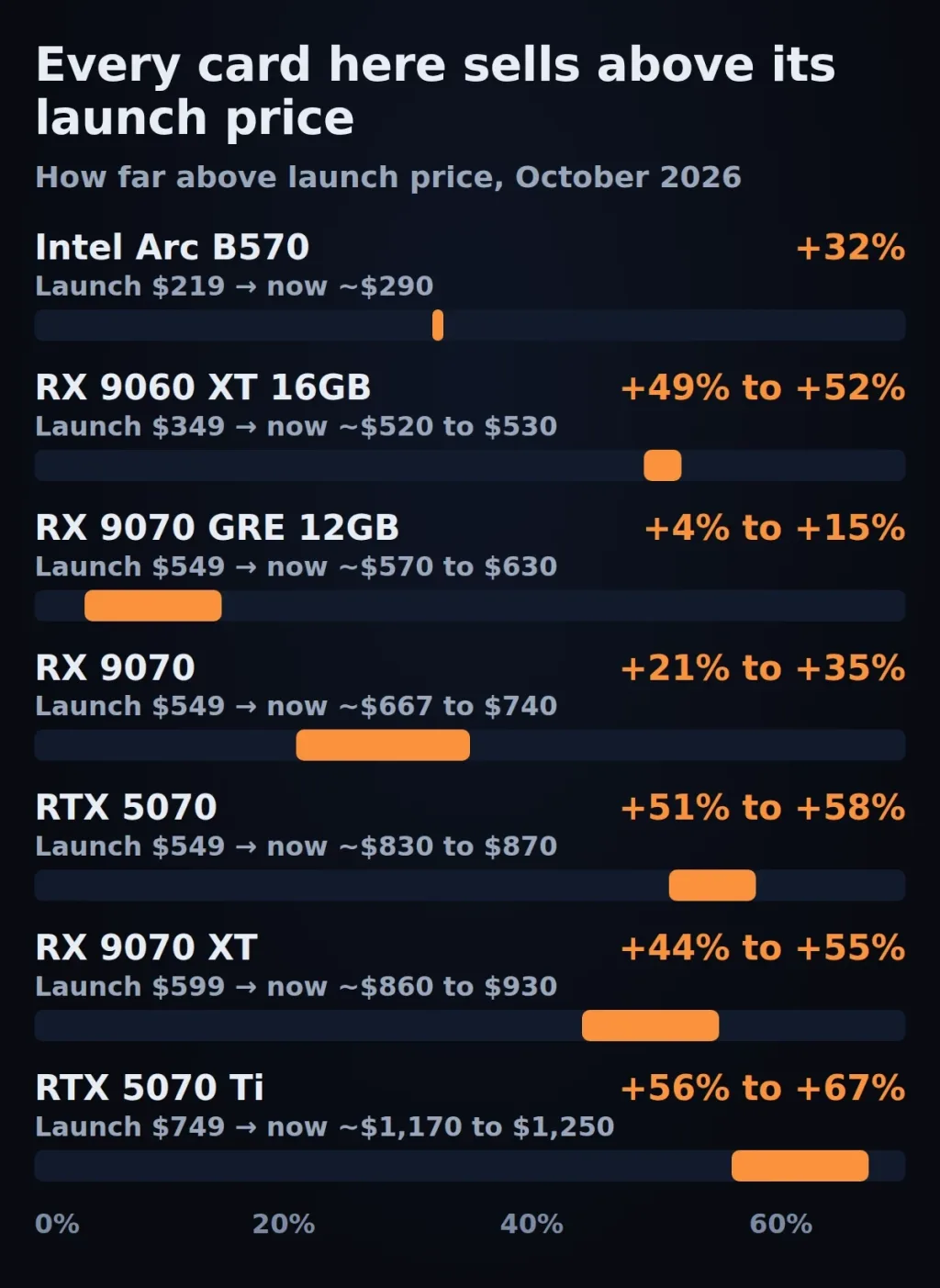
Every card in this guide costs more than its launch MSRP, and the gap isn't small. The RTX 5070 launched at $549 and was listed at about $830 to $870 at Newegg and Best Buy on October 7 and 8, 2026 — roughly 51% to 58% over MSRP. (It was as low as $499 in October 2025, per Tom's Hardware.) The RTX 5070 Ti launched at $749 and was listed at $1,169.99 to $1,249.99 on October 8, about 56% to 67% over MSRP. AMD's RX 9070 XT launched at $599 and was listed at $859.91 to $929.99 the same day, about 44% to 55% over.
The cause isn't a single company gouging buyers — it's an industry-wide shortage of the memory chips that go into graphics cards, driven largely by AI datacenter demand pulling the same memory supply that GPUs need. Cards with more VRAM have been hit hardest: higher-capacity variants of the same card are seeing steeper price increases than their lower-memory siblings, because more memory chips means more exposure to the shortage.
What this means practically: don't anchor your budget to a card's official MSRP. Check the current price before you buy, and treat anything you read that doesn't say when it checked prices with suspicion — including, six months from now, this guide. We'll note a last-checked date on the table below and update it as part of our normal content refresh cycle.
Best Graphics Cards by Tier — October 2026 Prices#
Prices checked October 6–8, 2026 from Newegg, Best Buy (store pickup at one Hawaii store) and Amazon listings, the same checks behind our individual guides. A spot-check on October 11–12 found the cheapest in-stock listings within about 6% of these figures, and no pick changed. Street prices change often during the current shortage — treat these as a snapshot, not a guarantee.
| Card | Tier | MSRP | Street Price (Oct 2026) | Best For |
|---|---|---|---|---|
| Intel Arc B570 | Budget | $219 | ~$290 | 1080p, tightest budget |
| RX 9060 XT 16GB | Budget/Value | $349 | ~$520–$530 | 1440p on a budget, VRAM headroom |
| RX 9070 GRE 12GB | Value | $549 | ~$570–$630 | 1440p near $500 |
| RX 9070 | Best Overall | $549 | ~$667–$740 | 1440p, best value overall |
| RTX 5070 | Mid-range | $549 | ~$830–$870 | 1440p, DLSS/software priority |
| RX 9070 XT | High-end | $599 | ~$860–$930 | 4K, 1440p high-refresh |
| RTX 5070 Ti | High-end | $749 | ~$1,170–$1,250 | 4K, if NVIDIA features matter |
| RTX 5090 | Flagship | $1,999 | No verified price (lowest in-stock US price was $3,980 in July, per TechSpot) | 4K/ultra, no budget ceiling |
Budget: Intel Arc B570#
Why it's here: At about $290 (Newegg, October 8), the Arc B570 is the most credible genuinely-cheap card in this guide. It's not a compromise pick you settle for — it handles 1080p gaming at solid framerates and has closed most of the driver-reliability gap that made early Arc cards a harder recommendation.
Who it's for: Budget 1080p builds, and anyone upgrading from a GPU old enough that almost anything current would feel like a big jump.
Caveat: Intel's driver support, while much improved, is still younger than NVIDIA's or AMD's, and Arc cards lean harder on your processor. TechSpot found the B570 lost much of its edge with a Ryzen 5 5600, so check your CPU first; our Best GPU Under $300 for 1080p Gaming guide explains how. And it costs about $90 more than its launch price, so if you can stretch to around $330, that guide makes the case for the Arc B580.
Best Overall: AMD Radeon RX 9070#
Why it's here: From about $667 (Newegg, October 7–8), the RX 9070 delivers some of the strongest performance-per-dollar of the cards we checked (only the RX 9070 GRE is close on cost per frame). It handles 1440p gaming comfortably and currently represents the best value in the entire lineup, NVIDIA or AMD.
Who it's for: Most gamers building or upgrading a 1440p system without a flagship budget.
Caveat: AMD's current-generation RDNA 4 cards have a much smaller installed base than NVIDIA's lineup right now, which can mean slightly slower day-one optimization in some new releases. In practice this is a minor point, not a dealbreaker.
Budget 1440p: AMD Radeon RX 9060 XT 16GB#
Why it's here: At about $520 to $530 for base models, this card's standout feature is its 16GB of VRAM, which gives it real headroom at 1440p and even light 4K that cards with less memory start to run into. It is the budget way into 1440p, not the best value near $500.
Who it's for: Buyers who want to stretch a mid-tier budget into 1440p longevity rather than chasing the highest raw framerate.
Caveat: Raw raster performance isn't class-leading — the 16GB of VRAM is the reason to pick this over a faster card with less memory, not outright speed.
Stretch option: RX 9070 GRE 12GB (~$570 to $630). If you can spend about $50 or more, the RX 9070 GRE is a faster 1440p card. Hardware Unboxed (via TechSpot, June 2026) measured it 5% behind the RTX 5070 and 16% behind the RX 9070, and we pick it as the best card near $500 in our Best GPU for 1440p Gaming Around $500 guide. It has 12GB, not 16GB, so it is a price-sensitive pick: above roughly $570, buy the RX 9070 instead.
1440p for NVIDIA Fans: RTX 5070#
Why it's here: At roughly $830 to $870, the RTX 5070 costs about $150 to $200 more than the RX 9070 while trailing it in raw raster performance (TechSpot measured 88 vs 100 fps at 1440p in June 2026). What it buys you is NVIDIA's software stack — DLSS upscaling and frame generation, which reviewers consistently point to as more mature and more widely supported across current AAA titles than AMD's FSR 4.
Who it's for: Buyers who weight DLSS/software-feature support higher than price-to-performance, or who are already invested in an NVIDIA-specific workflow (streaming tools, creative apps with CUDA support).
Caveat: You're paying a real premium over the RX 9070 for software features — make sure the games you actually play support them well before deciding that premium is worth it.
Best for 4K: AMD Radeon RX 9070 XT#
Why it's here: At $859.91 to $929.99, the RX 9070 XT is our 4K pick. In TechSpot's May 2026 testing it averaged 81 fps at 4K across 52 games, about 4% behind the RTX 5070 Ti (84 fps), which costs about a third more. It is also a strong 1440p high-refresh card. Our Best GPU for 4K Gaming in 2026 guide has the full comparison.
Who it's for: Buyers who want 4K at around 60 fps with upscaling without paying flagship prices.
Caveat: Same FSR-vs-DLSS trade-off as the RX 9070 — check your specific games' upscaling support before assuming feature parity with NVIDIA's stack.
4K Alternative: RTX 5070 Ti#
Why it's here: At $1,169.99 (Newegg) to $1,249.99 (Best Buy), the RTX 5070 Ti was only about 4% faster than the RX 9070 XT at 4K in TechSpot's May 2026 testing, for about a third more money. It makes sense only if NVIDIA's software stack matters to you, or if the price gap shrinks.
Who it's for: 4K gaming where NVIDIA's upscaling/frame-gen ecosystem matters to you and the RX 9070 XT's price-performance lead isn't enough to outweigh that.
Caveat: This card has seen one of the steepest price increases in this guide — about 56% to 67% over its $749 MSRP in the listings we checked on October 8. Confirm the current price before committing; it has moved a lot in recent months.
Flagship: RTX 5090#
Why it's here: It's the fastest consumer graphics card available, full stop. If money genuinely isn't the constraint, this is the card.
Who it's for: Buyers building a no-compromise 4K/ultra system, or professionals who also game and can justify the card on non-gaming workloads too.
Caveat: This is the one card in this guide we'd actively tell most people to skip right now. At its $1,999 MSRP it's already a flagship-tier purchase; we could not find a verified current price. No standalone card was in stock at Newegg or Best Buy on October 8, Amazon listings showed no price, and TechSpot's July 31, 2026 report put the lowest in-stock US price at $3,980. Unless you need 120 fps or more at 4K in new games, the RX 9070 XT does the job for a fraction of the price.
The VRAM Mistake Everyone Makes in 2026#
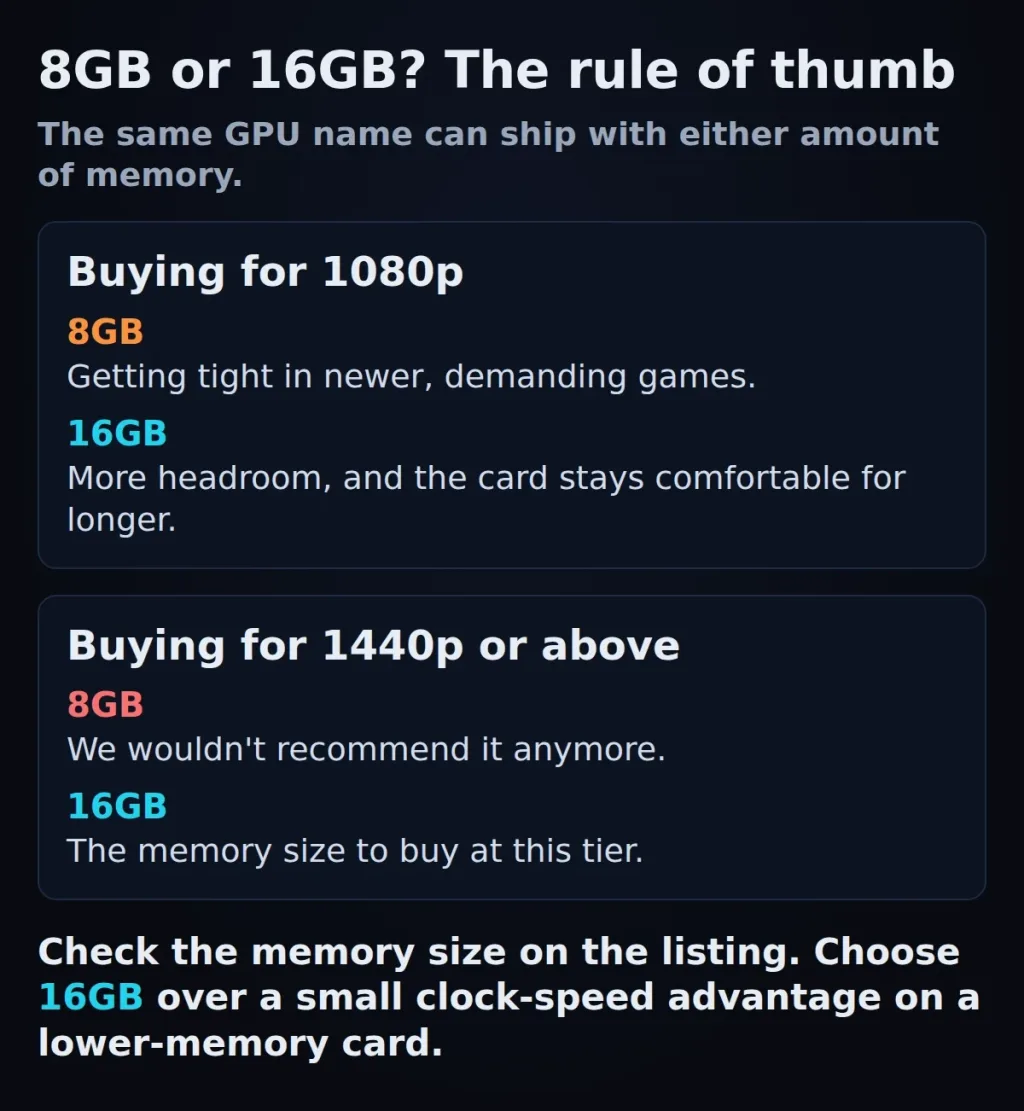
The single biggest point of confusion in this year's GPU market isn't NVIDIA vs. AMD — it's VRAM capacity, even within the same card name. Some cards ship in two memory configurations (an 8GB version and a 16GB version of what's otherwise the same GPU), and the price gap between them has widened enough that the higher-memory version can cost nearly as much as the next tier up.
The practical rule: 8GB is getting tight even at 1080p in newer, more demanding titles, and we wouldn't recommend it at 1440p or above anymore. If you're buying at the 1440p tier or higher, prioritize 16GB of VRAM over a small clock-speed advantage on a lower-memory card — it will matter more for how long the card stays comfortable to use.
How to Actually Choose#
Work through these in order:
- Pick your resolution and refresh rate first. 1080p/60-144Hz → budget tier. 1440p/high-refresh → mid-range. 4K → high-end or flagship. This decides your tier before anything else does.
- Set your budget using today's street price, not MSRP. Every card in this guide is selling well above its launch price right now — budgeting off MSRP will leave you short.
- Decide how much DLSS/FSR matters to you. If you play a lot of the newest AAA titles, NVIDIA's software lead is real and worth a premium to some buyers. If you mostly play older or less graphically demanding games, it matters much less.
- Check VRAM against the games you actually play, not just the resolution — 16GB+ is the safer floor at 1440p and above given current title trends.
- Buy from a retailer where you can see recent price history, especially during a shortage like this one — a "sale" price can still be well above what the card sold for two months ago.
If you want more detail at a specific budget, we've broken each tier out separately: Best GPU Under $300 for 1080p Gaming, Best GPU for 1440p Gaming Around $500, Best GPU for 4K Gaming in 2026, and RTX 5070 vs RX 9070: Which Should You Buy in 2026? for a direct head-to-head.
FAQ#
What's the best graphics card for 1080p gaming in 2026?
The Intel Arc B570 (about $290) is the strongest budget 1080p pick we checked, provided your processor is newer than a Ryzen 5 5600. If you can stretch to around $330, the Arc B580 is the better buy; see our 1080p guide.
Is 8GB of VRAM enough in 2026?
It's getting tight even at 1080p in newer titles, and we don't recommend it at 1440p or above. 16GB is the safer floor if you're buying at the mid-range tier or higher.
Why are GPU prices going up instead of down in 2026?
An industry-wide shortage of the memory chips used in graphics cards — driven largely by AI datacenter demand competing for the same supply — has pushed street prices well above MSRP across nearly every current card, NVIDIA and AMD alike.
RTX 5070 or RX 9070 — which should I buy?
The RX 9070 (~$667 to $740) offers better raw price-to-performance; the RTX 5070 (~$830 to $870 right now) costs more but includes NVIDIA's more mature DLSS/frame-generation software stack. See our dedicated comparison for a full breakdown.
Is Intel Arc worth it for gaming in 2026?
Yes, specifically at the budget tier. The Arc B570 is a legitimately solid 1080p card, with the caveat that Intel's driver support, while much improved, is still less mature than NVIDIA's or AMD's for less-common titles.
Should I wait for prices to come down before buying?
There's no clear sign of that happening soon — the shortage driving these prices has been building for months, not days. If you need a card now, buy based on today's price, not a hoped-for future one.
Conclusion#
GPU prices in 2026 don't look like a normal post-launch market — they look like a shortage, and every price in this guide reflects that. The RX 9070 is the best all-around value right now, from about $667. The Intel Arc B570 at about $290 is a genuinely good budget 1080p card, not just the cheapest option. And the RTX 5090, for all its raw power, is the one card here we'd tell most people to skip at today's prices unless they have a specific reason it has to be that card.
The tier that's right for you comes down to three questions, in order: what resolution are you actually gaming at, how much does NVIDIA's software ecosystem matter to your specific game library, and have you checked today's price rather than the number stuck in your head from a launch article months ago. Get those three right and the rest of this guide should make the decision straightforward.
We'll keep this guide's price table updated as the market moves — check the "last updated" date above before relying on any number here.
Comments
No comments yet. Be the first.
Leave a comment
Loading comments...